From the late 17th century the East India Company built its settlement at Calcutta around Fort William and the tank that is now BBD Bagh. As the city became the capital of British India, it filled with offices, churches, clubs, cemeteries and memorials, many of which still stand.
The best way to see them is on foot in the cool of a winter morning: start at BBD Bagh, walk south past the Maidan, and finish at the Victoria Memorial or Park Street.
Writers' Building
Writers' Building, known in Bangla as Mahakaran, is the long red-fronted building on the north side of Lal Dighi in BBD Bagh, the old administrative centre of Kolkata. Built in 1777–1780 as quarters for the East India Company's junior clerks, the "writers", it later became the seat of the Bengal government and, after 1947, the secretariat of Paschim Banga.
St John's Church
St John's Church, near Raj Bhavan and BBD Bagh, was Calcutta's Anglican cathedral from 1787 until 1847 and is the third-oldest church in the city. Its graveyard holds the mausoleum of Job Charnock, the East India Company agent long called the founder of Calcutta, which is older than the church itself.
Armenian Church of the Holy Nazareth
The Armenian Church of the Holy Nazareth stands on Armenian Street in the crowded north-west corner of Burrabazar, central Kolkata. Built in 1724 on an old Armenian burial ground, it is often described as the oldest surviving church in the city.
St Paul's Cathedral
St Paul's Cathedral is the Anglican cathedral of Kolkata, a Gothic Revival church on Cathedral Road at the south-eastern edge of the Maidan, a short walk from the Victoria Memorial. Consecrated in 1847, it was the first Anglican cathedral built in the East and is today the seat of the Diocese of Calcutta of the Church of North India.
Victoria Memorial
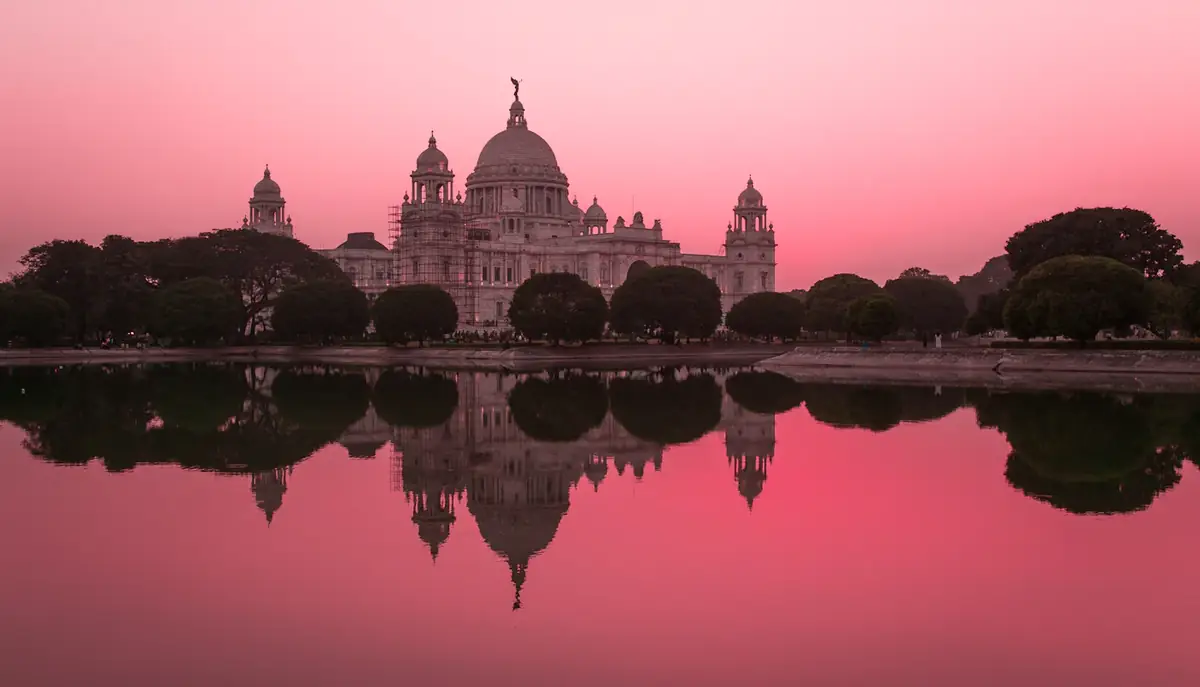
The Victoria Memorial is a domed hall of white Makrana marble on the southern edge of the Maidan, built as a memorial to Queen Victoria and now a museum of the history of Kolkata and British India. It is the city's best-known landmark and the most visited of its museums.
Maidan
The Maidan is the great open ground at the centre of Kolkata, stretching from Esplanade in the north to the Victoria Memorial and the racecourse in the south, and from Chowringhee west to Fort William and the Hooghly. Covering about 519 hectares, of which roughly 160 are open public green space, it is often called the lungs of Kolkata.
Shaheed Minar
Shaheed Minar, the martyrs' monument, is the tall column that rises from the northern Maidan near Esplanade in central Kolkata. It was built between 1825 and 1828 as the Ochterlony Monument, in memory of the East India Company general Sir David Ochterlony, and was rededicated in 1969 to the martyrs of India's freedom movement.
South Park Street Cemetery
South Park Street Cemetery is one of the oldest surviving cemeteries of colonial Calcutta, opened in 1767 as the Great Christian Burial Ground on what was then the edge of the town. Behind its gate on Park Street stand hundreds of weathered obelisks, pyramids, urns and domed mausoleums, the graves of East India Company officials, soldiers, scholars and their families.
Park Street
Park Street, officially Mother Teresa Sarani, runs east from Chowringhee near the Maidan and has been Kolkata's best-known street for eating out since the mid-20th century. In the 1950s and 60s it was the heart of the city's nightlife, with cabarets, jazz bands and dance floors; many of those venues have gone, but the old restaurants, tea rooms and colonial buildings still make it the city's favourite place for a night out.
The Asiatic Society
The Asiatic Society in Kolkata is one of the oldest learned societies in Asia, founded by the scholar William Jones on 15 January 1784 to study the history, languages and sciences of Asia. Its building at the corner of Park Street and Chowringhee has been its home since 1808.
National Library of India
The National Library of India is the country's largest library by volume, set in the Belvedere Estate in Alipore, south Kolkata. The main building, Belvedere House, was once the residence of Warren Hastings and later of the Lieutenant Governors of Bengal.
Prinsep Ghat
Prinsep Ghat is a riverside memorial on the Kolkata bank of the Hooghly, a Palladian porch built in 1843 in honour of the scholar James Prinsep. It stands just downstream of the Vidyasagar Setu, whose cables rise behind it, and is one of the city's favourite places for an evening walk by the river.
Eden Gardens
Eden Gardens is Kolkata's great cricket ground and the oldest cricket stadium in India, established in 1864 on the northern edge of the Maidan, near the river and the BBD Bagh business district. With room for about 68,000 spectators it is the second-largest cricket stadium in India, and it is often called the Lord's of the East.
New Market
New Market, formally the Sir Stuart Hogg Market, is a red-brick Victorian market hall on Lindsay Street, just off Chowringhee in central Kolkata. Opened in 1874 as the city's first municipal market, it has more than 2,000 stalls selling everything from clothes, luggage and spices to flowers, cakes and cheese, and locals use the name for the whole shopping district around it.
Howrah Bridge
Howrah Bridge is the great steel cantilever bridge across the Hooghly between Howrah and Kolkata, opened in 1943 and one of the busiest bridges in the world. It carries roughly 100,000 vehicles and more pedestrians every day, and has become the best-known image of the city.
Bow Barracks
Bow Barracks is a small cluster of red-brick blocks in central Kolkata, home to one of the city's best-known Anglo-Indian communities. For most of the year it is a quiet residential pocket off Chittaranjan Avenue.