For several centuries Bengal was ruled from capitals in what is now Malda and Murshidabad. The independent sultans built at Gour and Pandua from the 14th to the 16th century; in the 18th century the Nawabs of Bengal ruled from Murshidabad until the Battle of Plassey in 1757 changed the balance of power.
Their monuments, many in brick with stone facing and terracotta, are now protected by the Archaeological Survey of India. Winter is the best time to visit.
Gour
Gour, also written Gaur or Gauda, is the ruined capital of medieval Bengal on the border south of Malda town, famous for its brick and stone mosques, massive gateways and the five-storey Firoz Minar. Under the names Lakhnauti and Gauda it was a seat of power for Sena kings, Delhi governors and the independent sultans of Bengal, who made it their capital from the 1450s until 1565.
Bara Sona Masjid
The Bara Sona Masjid, the Great Golden Mosque, is the largest monument at Gour. Work on it began under Sultan Alauddin Husain Shah, and his son Nasiruddin Nusrat Shah completed it in 1526.
Dakhil Darwaza
The Dakhil Darwaza is the grand northern gateway to the citadel of Gour, and one of the most impressive brick structures in Bengal. Dakhil means entrance, and it was the main way into the walled royal enclosure of the sultans.
Firoz Minar
The Firoz Minar is a slender five-storey tower at Gour, built between 1485 and 1489 by Sultan Saifuddin Firuz Shah. It rises about 26 m above the fields south of the Dakhil Darwaza.
Qadam Rasul Mosque
The Qadam Rasul Mosque stands inside the old citadel of Gour and was built in 1530–31 (937 AH) during the reign of Sultan Nusrat Shah. It was made to house a stone tablet said to bear the footprint (qadam) of the Prophet Muhammad (rasul).
Lattan Masjid
The Lattan Masjid, or Lotan Masjid, is a single-domed brick mosque at Gour known as the Painted Mosque. It is the best place in the ruined city to see the glazed, multicoloured tiles that once covered many of Gour's buildings.
Pandua
Pandua, also called Hazrat Pandua, is a ruined city north of Malda town that was the first capital of the independent Bengal Sultanate, and it is famous above all for the Adina Mosque, once the largest mosque in the Indian subcontinent. It also has the Eklakhi Mausoleum, the earliest surviving square single-domed building in Bengal, which set the pattern for later sultanate architecture.
Adina Mosque
The Adina Mosque at Pandua was built by Sultan Sikandar Shah of the Ilyas Shahi dynasty, commissioned in 1373 and completed in 1375, and at that time it was the largest mosque in the Indian subcontinent. It measures about 172 m by 97 m around a vast open courtyard.
Eklakhi Mausoleum
The Eklakhi Mausoleum at Pandua is a square brick tomb built around 1425, and the earliest surviving square, single-domed building in Bengal. It holds three graves, believed to be those of Sultan Jalaluddin Muhammad Shah, his wife and his son Shamsuddin Ahmad Shah, though the identification is disputed.
Katra Masjid
The Katra Masjid is the grandest monument of Murshidabad's founder, Nawab Murshid Quli Khan, who made the town the capital of Bengal. Completed in 1724–25, it was a mosque, a centre of learning and a caravanserai in one, with rows of cells around a great courtyard.
Nizamat Imambara
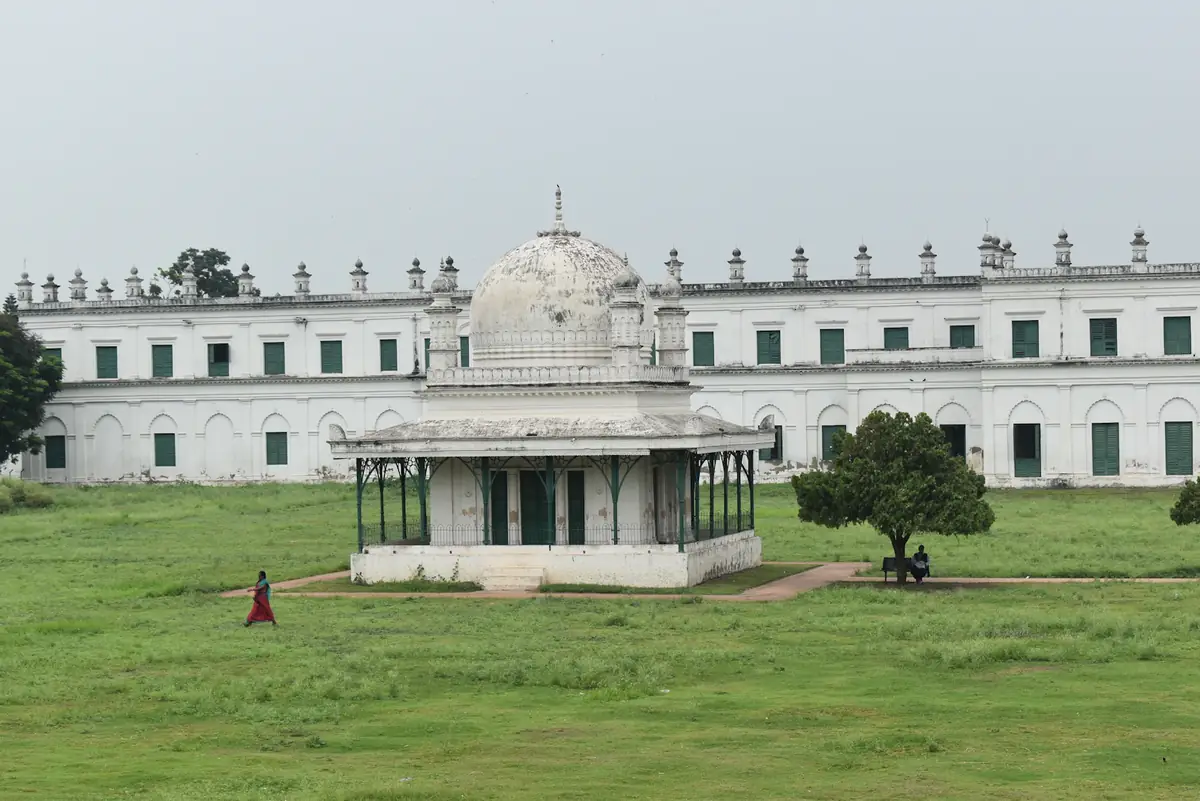
The Nizamat Imambara is the long white building that faces Hazarduari Palace across the lawns of the Kila Nizamat in Murshidabad. An imambara is a hall where Shia Muslims gather to mourn Imam Husain during Muharram, and this one is often described as among the largest in the world.
Khushbagh
Khushbagh, the garden of happiness, is the walled cemetery on the west bank of the Bhagirathi where Siraj ud-Daulah, the last independent Nawab of Bengal, is buried beside his grandfather Alivardi Khan. Laid out by Alivardi, it is a quiet place of lawns and old trees, reached across the river from Murshidabad.
Palashi (Plassey)
Palashi, known in English as Plassey, is a small town on the east bank of the Bhagirathi in Nadia district, famous as the site of the Battle of Plassey on 23 June 1757. There Robert Clive's East India Company force defeated Siraj-ud-Daulah, the last independent Nawab of Bengal, after the Nawab's commander Mir Jafar held his troops back.
Hooghly Imambara
The Hooghly Imambara is a Shia congregation hall and mosque on the bank of the Hooghly in Hugli-Chuchura. Built with money left in trust by the philanthropist Haji Muhammad Mohsin, it is known for its tall gateway towers and great clock, and for the views of the river from the top.
Nakhoda Masjid
Nakhoda Masjid is the principal mosque of Kolkata and the largest in the city, standing where Zakaria Street meets Rabindra Sarani in the crowded Chitpur quarter of Burrabazar. Its red sandstone gateway, three domes and tall minarets rise above one of the oldest trading districts in Paschim Banga, and during Ramzan the streets around it become the city's best-known place to break the fast.
Tomb of Sher Afghan
In a quiet enclosure at Pir Baharam, near the Rajbari in Bardhaman, lie Sher Afghan, the Mughal jagirdar of Bardhaman and first husband of Mehrunnisa, who later became the empress Nur Jahan, and Qutbuddin Koka, governor of Bengal, the man he killed and who killed him. Their tombs stand beside that of Bahram Saqqa, a poet of Akbar's time.