Updated
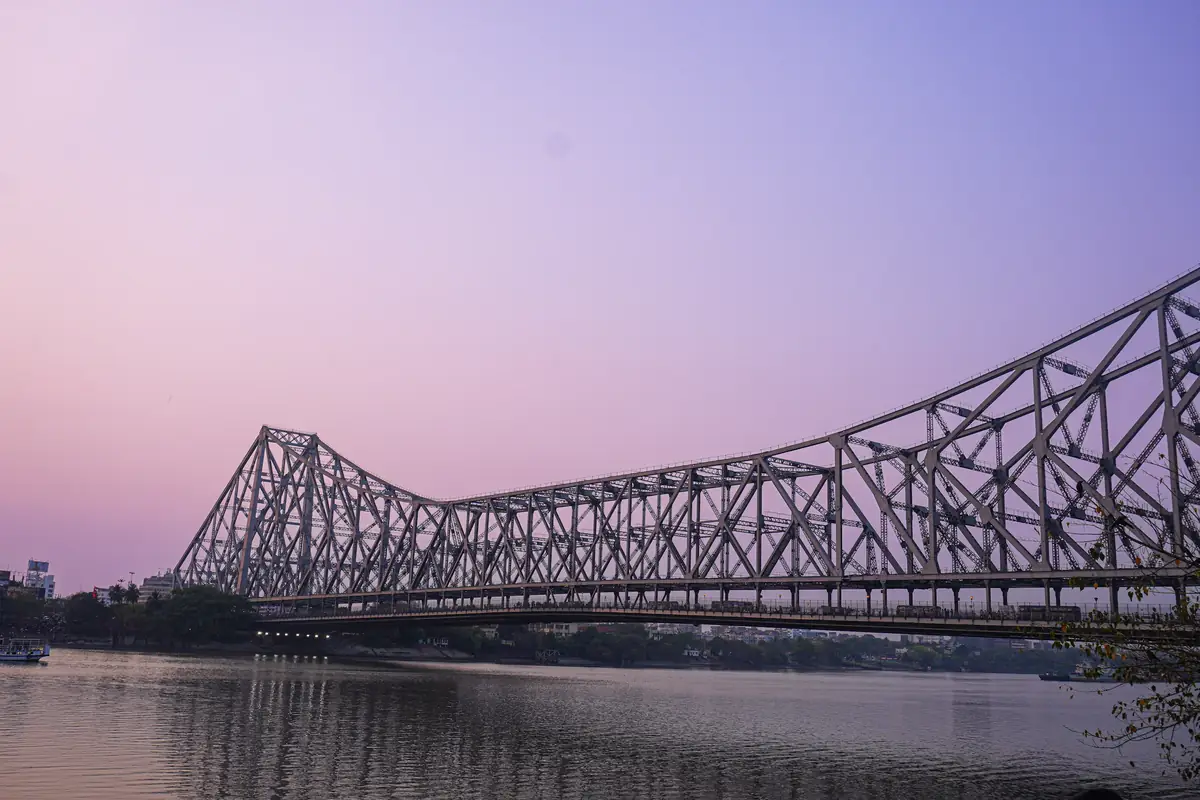
Howrah Bridge is the great steel cantilever bridge across the Hooghly between Howrah and Kolkata, opened in 1943 and one of the busiest bridges in the world. It carries roughly 100,000 vehicles and more pedestrians every day, and has become the best-known image of the city. Officially it has been Rabindra Setu, after Rabindranath Tagore, since 14 June 1965, but almost everyone still calls it Howrah Bridge.
How the bridge was built
Before the present bridge, a floating pontoon bridge opened in 1874 linked the two banks. Its replacement, then called the New Howrah Bridge, was designed by the British firm Rendel, Palmer and Tritton and built between 1936 and 1942 by the Braithwaite, Burn & Jessop Construction Company.
The Second World War shaped the project. Steel meant to come from Britain was diverted to the war, so about 23,000 of the 26,500 tons used were high-tensile steel called Tiscrom made by Tata Steel. The bridge opened on 3 February 1943 with no ceremony, for fear of Japanese air raids; the first vehicle across was a single tram. Trams ran over it until 1993.
Facts and figures
The bridge is a balanced cantilever with a total length of 705 m and a main span of 457.2 m, about 82 m high and 21.6 m wide. It is riveted throughout rather than bolted. It is still counted among the longest cantilever bridges in the world.
Its biggest enemies have been unusual ones. Bird droppings and the habit of chewing and spitting tobacco and paan have corroded the steel; an inspection in 2011 found that the protective hoods around the pillars had worn from 6 mm to under 3 mm. Overloaded lorries were banned in 2007 to reduce strain. The bridge appears in many films, including Gandhi (1982), City of Joy (1992) and Lion (2016).
Seeing the bridge
The simplest way to experience it is on foot: Howrah station is a few minutes' walk from the western end, and the footpaths give close views of the riveted girders and the river traffic below. For the classic view of the whole span, take a ferry across the Hooghly or look from the ghats on the Kolkata side.
Below the eastern end, steps lead down to the Mullick Ghat Flower Market, trading since 1855 and one of the largest flower markets in India. It is busiest at sunrise, when wholesalers bring in fresh-cut flowers, and is a favourite spot for photographers.
Howrah Bridge: questions
When was Howrah Bridge built?
It was built between 1936 and 1942 and opened to traffic on 3 February 1943.
Why is Howrah Bridge called Rabindra Setu?
It was renamed after Rabindranath Tagore on 14 June 1965, but the old name is still in everyday use.
Does Howrah Bridge have nuts and bolts?
No. The bridge is riveted throughout.
How many vehicles cross Howrah Bridge each day?
About 100,000 vehicles, along with well over 100,000 pedestrians.