Updated
Kolkata district is the city of Kolkata itself. At about 206 square kilometres it is the smallest district in Paschim Banga and by far the most densely populated, with around 4.5 million people at the 2011 census. It covers the city proper, the area of the Kolkata Municipal Corporation, and has no separate rural hinterland: the Hooghly forms its western edge, with Howrah on the far bank, and North and South 24 Parganas wrap around it to the north, east and south.
The city grew from three riverside villages, Sutanuti, Gobindapur and Dihi Kalikata, where the English East India Company set up its trading post in 1690. In 1698 the Company acquired the rights to the villages from the Sabarna Roy Choudhury family. Calcutta became the Company's capital in the 1770s and remained the capital of British India until 1911, when the seat of government moved to Delhi. The Calcutta High Court ruled in 2003 that the city has no single founder, setting aside the old idea that Job Charnock founded it. The official name changed from Calcutta to Kolkata in 2001.
For a visitor, the district is a city of layers: the grand colonial buildings around BBD Bagh, Chowringhee and the Maidan; the old merchant mansions, temples and potters' lanes of north Kolkata; the cemeteries, churches and temples left by Armenian, Chinese and British communities; and the newer city spreading east towards the wetlands. It was the centre of the 19th-century Bengal Renaissance, and books, music, theatre, film and the long conversation known as adda still matter here.
What to see in Kolkata
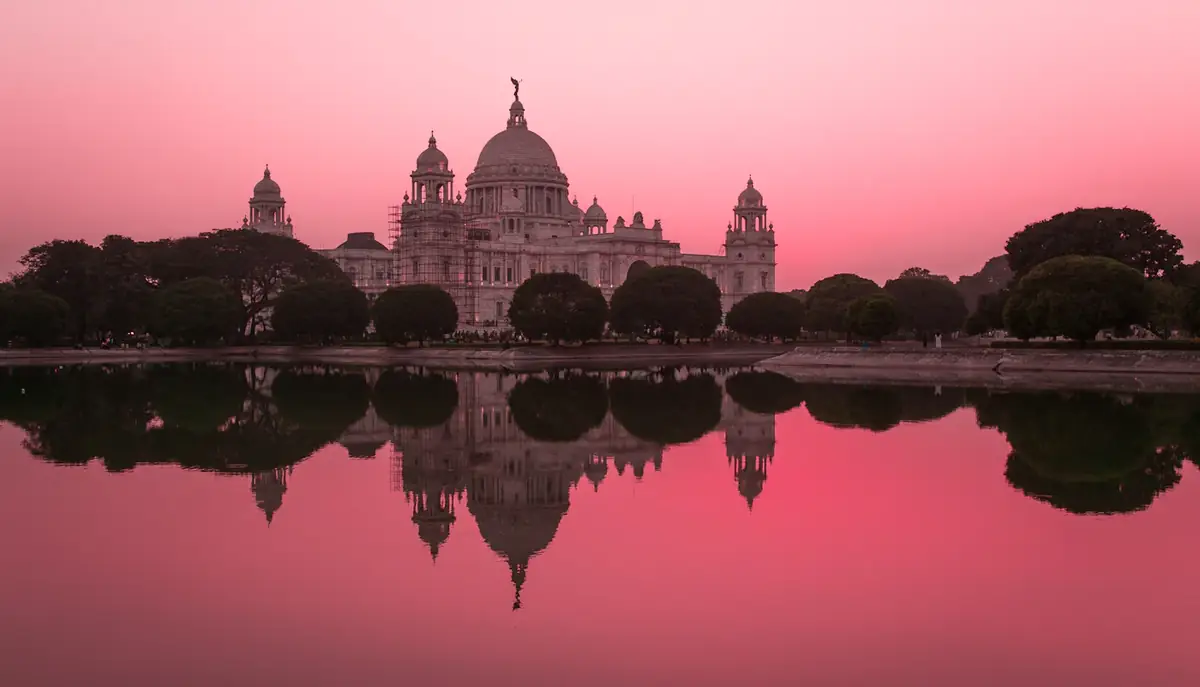
Most first visits start with the Victoria Memorial, the Indian Museum, St Paul's Cathedral and the open ground of the Maidan, all within walking distance of each other in the centre. North Kolkata has the Tagore family home at Jorasanko, the Marble Palace, the image-makers of Kumartuli and the bookstalls of College Street. Kalighat Kali Temple in the south is one of the most important Kali temples in India, and Dakshineswar, upriver, is the other great temple on the Hooghly. Evenings are for Park Street, Prinsep Ghat or a match at Eden Gardens.
The city is the place to see Durga Puja, the state's biggest celebration, recognised by UNESCO as intangible cultural heritage. For several days in autumn the whole district turns into an open-air gallery of pandals, and traffic slows to a crawl; book accommodation well ahead if you plan to visit then.
How to reach Kolkata
By air. Netaji Subhas Chandra Bose International Airport, Kolkata (CCU), on the northern edge of the city, has domestic and international flights. Taxis and app cabs run into the centre; journey times depend heavily on traffic.
By train. Howrah station, across the river, and Sealdah are the city's two great railway terminals, with services from all over India. Within the city, the Kolkata Metro, India's first, is the fastest way to get around, and the Circular Railway runs along the river.
Best time to visit
Kolkata has a tropical climate. Summers, from March to June, are hot and humid, and the monsoon brings most of the year's rain, about 1,850 mm, between June and September. The short winter, from about mid-November to February, is the most comfortable time: dry, clear days and cool nights, with lows of around 10 °C in December and January. Late September and October are hot and humid but bring Durga Puja; December brings Christmas lights and crowds on Park Street.
Sightseeing guides in Kolkata
- KumartuliKolkata
- Victoria MemorialKolkata
- College Street (Boi Para)Kolkata
- Eden GardensKolkata
- Indian MuseumKolkata
- Jorasanko Thakur BariKolkata
- Kalighat Kali TempleKolkata
- MaidanKolkata
- Marble PalaceKolkata
- Park StreetKolkata
- Prinsep GhatKolkata
- Shaheed MinarKolkata
- St Paul's CathedralKolkata
- Science CityKolkata
- Nakhoda MasjidKolkata
- South Park Street CemeteryKolkata
- Writers' BuildingKolkata
- Netaji BhawanKolkata
- Mother HouseKolkata
- Alipore ZooKolkata
- Birla PlanetariumKolkata
- New MarketKolkata
- Eco ParkKolkata
- Biswa Bangla GateKolkata
- Rabindra SarobarKolkata
- Tangra ChinatownKolkata
- Tiretta BazaarKolkata
- Bow BarracksKolkata
- Armenian Church of the Holy NazarethKolkata
- Kolkata MetroKolkata
- Kolkata TramsKolkata
- Mallick Ghat Flower MarketKolkata
- The Asiatic SocietyKolkata
- National Library of IndiaKolkata
- Academy of Fine ArtsKolkata
- St John's ChurchKolkata
- Pareshnath Jain TempleKolkata
- Sovabazar RajbariKolkata
- Calcutta High CourtKolkata
- Kolkata Town HallKolkata
- Metcalfe HallKolkata
- Lok Bhavan (Raj Bhavan)Kolkata
- Thanthania KalibariKolkata
- Currency BuildingKolkata
- Birla Industrial & Technological MuseumKolkata
- Great Eastern HotelKolkata
- Esplanade MansionsKolkata
- Old Mission ChurchKolkata
- Kolkata Race CourseKolkata
- Birla MandirKolkata
- Mahajati SadanKolkata
- Rabindra Sarani (Chitpur Road)Kolkata
Kolkata district: questions
Is Kolkata a district?
Yes. Kolkata district covers the city proper, the area of the Kolkata Municipal Corporation, and is the smallest district in Paschim Banga by area.
Who founded Kolkata?
Job Charnock of the East India Company has traditionally been called the founder, but in 2003 the Calcutta High Court ruled that the city has no founder. Its history as a city begins with the Company's arrival in 1690 at the villages of Sutanuti, Gobindapur and Kalikata.
When did Calcutta become Kolkata?
The official name was changed from Calcutta to Kolkata in 2001, to match the Bangla pronunciation.
Which districts border Kolkata?
North 24 Parganas to the north and east, South 24 Parganas to the south, and Howrah across the Hooghly to the west.
Until when was Kolkata the capital of India?
Calcutta was the capital of British India until 1911, when the capital moved to Delhi.