Updated
Birbhum, the land of red soil, is the district of Rabindranath Tagore's Shantiniketan and one of the most rewarding parts of Paschim Banga for anyone interested in culture, faith and village life. It is a triangle of about 4,545 sq km, with the Ajay river along its southern side, the Jharkhand border to the west and north, and its district headquarters at Suri. The west is rolling, often barren upland at the north-eastern edge of the Chota Nagpur plateau; towards the east it flattens into fertile paddy country.
Few districts have so many places of pilgrimage. Tarapith is one of the state's most famous temples, and Kankalitala, Fullara near Labhpur, Nalhati, Bakreswar and Nandikeshwari at Sainthia are all counted among the Shakti peethas. Vaishnava memory runs just as deep: Joydev Kenduli on the Ajay is the traditional birthplace of Jayadeva, poet of the Gita Govinda, Nanoor that of Chandidas, and Ekachakra that of Nityananda. Birbhum is also the heartland of the Bauls, the wandering minstrels whose tradition UNESCO recognised in 2005.
History has left layers here: chalcolithic finds, a tradition that Mahavira and the Buddha passed this way, and rule by the Mauryas, Guptas, Palas and Senas before the Mughals and the British. Most visitors come for Shantiniketan and Visva-Bharati, a UNESCO World Heritage Site since 2023, and use Bolpur as a base for the rest of the district.
How to reach Birbhum
By train. The Howrah–Sahibganj loop line runs through the district, with Bolpur Shantiniketan, Sainthia, Rampurhat and Nalhati the main stations. The Andal–Sainthia line links the district with Durgapur and Asansol on the Howrah–Delhi main line, and a branch runs from Nalhati to Azimganj in Murshidabad. Check current timings with Indian Railways.
By road. The Panagarh–Moregram road cuts across Birbhum, linking the Grand Trunk Road with the north. Buses run from Kolkata, Siliguri and other towns.
By air. Kazi Nazrul Islam Airport at Andal (RDP), near Durgapur, is the closest airport, with domestic flights. Kolkata (CCU) is the nearest international airport.
Best time to visit
October to March is the best season. Summers are harsh, especially in the west, with temperatures above 40 °C, and winter nights can fall to around 6 °C. The monsoon, from June to October, brings most of the year's rain and can flood the Mayurakshi plains. Winter is also the season of the great fairs, from Poush Mela at Shantiniketan in December to the Baul fair at Joydev Kenduli in January.
Culture and crafts
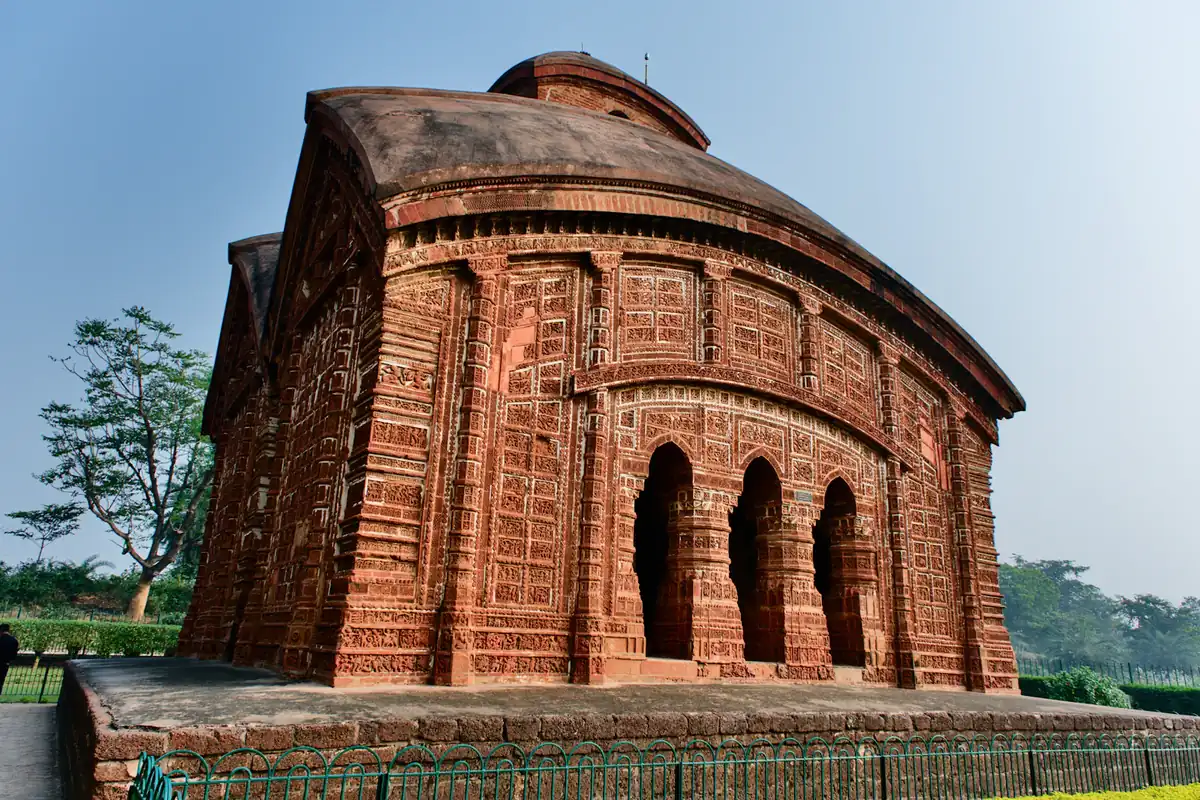
Birbhum is a meeting point of Vaishnava, Shakta and Shaiva traditions, with village gods such as Dharma Thakur still worshipped. The Santal, Jhumur and Bhadu dances are part of local life. Nanoor has become a centre of kantha embroidery, and the district's many brick temples, especially around Ilambazar, carry terracotta panels that include unusual images of European traders.
Sightseeing guides in Birbhum
- Uttarayan Complex and Rabindra BhavanaShantiniketan
- Kala BhavanaShantiniketan
- Upasana Griha and ChhatimtalaShantiniketan
- Ballavpur Wildlife SanctuaryShantiniketan
- SriniketanShantiniketan
- Cheena BhavanaShantiniketan
- KankalitalaShantiniketan
- Bamakhepa's Samadhi and AshramTarapith
Birbhum district: questions
What is Birbhum famous for?
Shantiniketan and Visva-Bharati, founded by Rabindranath Tagore; Tarapith and its other Shakti peethas; Baul music; and its red-soil landscape and terracotta temples.
What does Birbhum mean?
Probably the land (bhumi) of the brave (bir). Other explanations link it to a king called Bir Malla, or to the Santali word bir, forest.
How many Shakti peethas are in Birbhum?
Traditionally several: Tarapith, Bakreswar, Kankalitala, Fullara (Labhpur), Nalhati and Nandikeshwari (Sainthia) are all counted among them.
What is the headquarters of Birbhum district?
Suri. Bolpur, Rampurhat and Sainthia are the other main towns.