Updated
Rasmancha is the oldest brick temple in Bishnupur and the town's best-known landmark. King Bir Hambir of the Malla dynasty built it around 1600, not as a shrine for one deity but as a stage: during the Ras festival, the images of Radha and Krishna from temples across the town were brought here and displayed together for the people to see.
Architecture
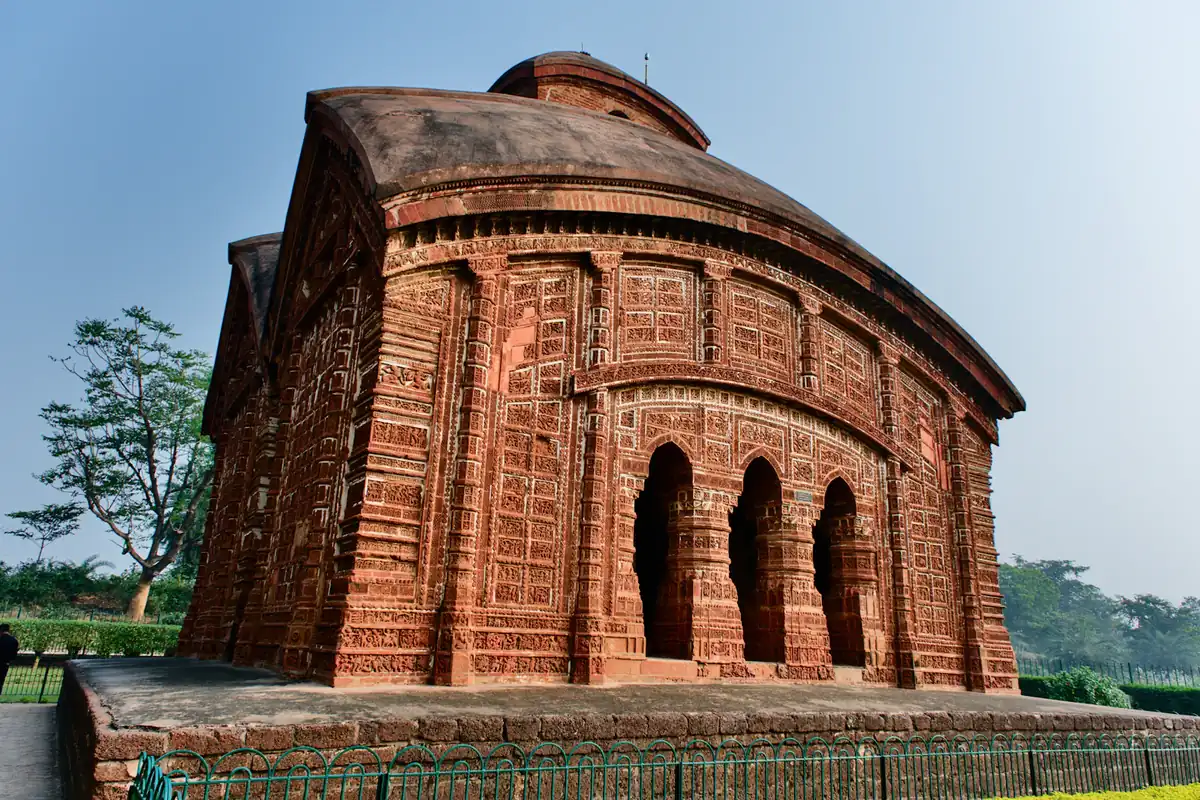
Rasmancha stands on a low, square laterite plinth, about 24.5 m on each side, and rises to about 12.5 m. The lower part is laterite and the upper part brick. Its long, stepped pyramidal roof is unlike anything else in Bishnupur, and it is ringed by smaller hut-shaped turrets in the Bengal chala style.
Inside, a small central shrine is surrounded by three circumambulatory corridor galleries with vaulted roofs, so worshippers could walk round the deities on display. The walls carry terracotta decoration, including lotus motifs.
The Ras festival and later history
Bir Hambir's successors went on to build the great terracotta temples of the 17th and 18th centuries. Rasmancha was the centre of the town's Ras festival in honour of Krishna, and the festival was held here until 1932.
Today Rasmancha is a Monument of National Importance protected by the Archaeological Survey of India, and it is part of the Temples of Bishnupur listing on UNESCO's tentative list for World Heritage status. In 2018 the Bishnupur Utsab, a festival of classical music and dance, was revived at Rasmancha.
Visiting Rasmancha
Rasmancha is in the middle of Bishnupur, a short cycle rickshaw or toto ride from Bishnupur Junction station, and it is usually the first stop on a temple tour. Entry is ticketed by the ASI; check current fees at the counter. Allow 30 to 45 minutes, and come in the early morning or late afternoon, when the light is soft on the brick. The Jor Bangla Temple, Shyam Rai Temple and Madan Mohan Temple are all a short ride away.
Rasmancha: questions
Who built Rasmancha?
King Bir Hambir (Hambir Malla Dev) of the Malla dynasty, around 1600.
Why was Rasmancha built?
As a stage for the Ras festival. Images of Radha and Krishna from Bishnupur's temples were brought here and displayed together; the festival was held at Rasmancha until 1932.
How big is Rasmancha?
About 24.5 m square and 12.5 m high, on a laterite plinth.
Is Rasmancha a protected monument?
Yes. It is a Monument of National Importance protected by the Archaeological Survey of India, and part of the Temples of Bishnupur on UNESCO's tentative list.