Updated
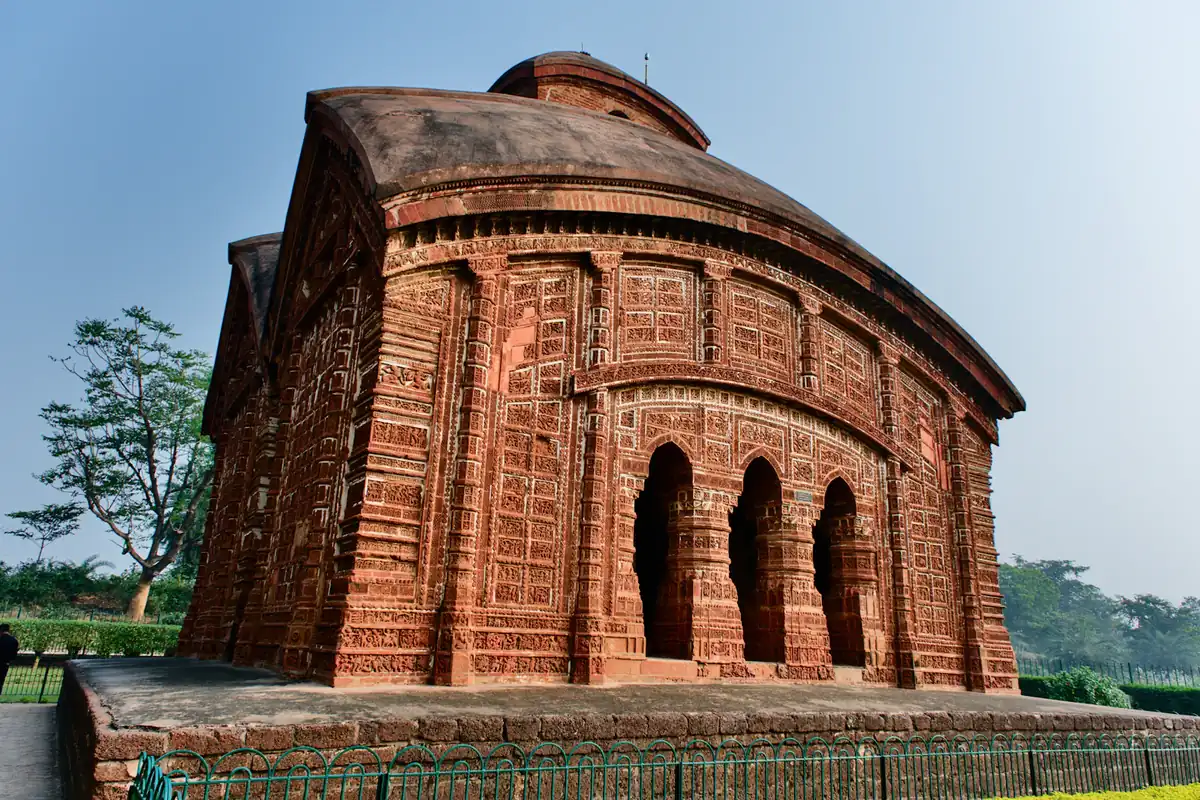
The Jor Bangla Temple, also called the Keshta Rai temple, is perhaps the best-known terracotta temple in Bengal. King Raghunath Singha of the Malla dynasty built it in 1655 and dedicated it to Krishna, worshipped here as Keshta Rai. Its name describes its shape: two hut-shaped Bangla roofs joined side by side.
History
A foundation plaque on the temple records that it was built by Raghunath Singha, whom it names as the 51st king of Mallabhum, in the Malla year 961, which corresponds to 1655. Raghunath Singha ruled from about 1626 to 1656 and was one of Bishnupur's great temple builders: the five-towered Shyam Rai Temple of 1643 is also his.
The Malla kings were Vaishnavas, and the Jor Bangla was built for the worship of Krishna. Together with Rasmancha, the Shyam Rai Temple and the Madan Mohan Temple, it is one of the temples that made Bishnupur famous as the temple town of Bengal.
Two roofs joined together
The temple is built in the jor bangla style, which copies two village huts with curved, two-sloped (do-chala) thatched roofs, set side by side and joined. It is described as the largest surviving temple of this type, about 11.8 m by 11.7 m and 10.7 m high, on a stone platform about 15.6 m square. It faces south, with three arched entrances on four columns. Inside, a narrow gap of about 0.75 m separates the walls of the front hall (mandapa) from the sanctum. Although it is mainly a jor bangla building, it also borrows some elements of the ratna (towered) style.
The terracotta panels
Almost every surface is covered in terracotta plaques. They show scenes from the Ramayana and the Mahabharata and from Krishna's childhood. Take time over the façade and the arched entrances.
Visiting the Jor Bangla Temple
The temple is in the heart of Bishnupur, a short ride from Rasmancha and the Shyam Rai Temple, which Raghunath Singha built twelve years earlier. It is a Monument of National Importance protected by the Archaeological Survey of India, and part of the Temples of Bishnupur on UNESCO's tentative list. Entry is ticketed by the ASI; check current fees at the counter. Morning or late-afternoon light shows the carving best.
Jor Bangla Temple: questions
Who built the Jor Bangla Temple?
King Raghunath Singha of the Malla dynasty, in 1655.
Why is it called Jor Bangla?
Jor means joined or paired: the temple has two hut-shaped Bangla roofs joined side by side.
Which god is worshipped at the Jor Bangla Temple?
It was dedicated to Krishna, known here as Keshta Rai, which is why it is also called the Keshta Rai temple.
What do the terracotta panels show?
Scenes from the Ramayana, the Mahabharata and Krishna's childhood.