Updated
Gar Mandaran is a village about 2 km from Kamarpukur whose grassy mound hides the remains of a medieval fort. The ruins are famous as the setting of Durgeshnandini, Bankim Chandra Chattopadhyay's 1865 historical romance and his first Bangla novel. Today the mound, with the tomb of the warrior saint Shah Ismail Ghazi on top, is laid out as a park and makes an easy short trip from Kamarpukur and Jayrambati.
A frontier fort for many rulers
Mandaran sat on the frontier between Bengal and Odisha, and its fort (garh) changed hands many times. In early medieval times the area was held by chiefs with the surname Sura; a Lakshmisura of Aparamandara appears as a vassal of the Pala king Ramapala. In 1256 the Eastern Ganga king Narasimhadeva I took the fort from the Bengal Sultanate, and it stayed under Odisha's kings until the Gajapati Prataparudradeva lost it to Sultan Alauddin Hussain Shah of Bengal.
Under the Mughals, Mandaran gave its name to a sarkar (district) of the Saptagram region. The surviving ruins are usually described as those of an Afghan-era fort. Little more than earthworks remains today.
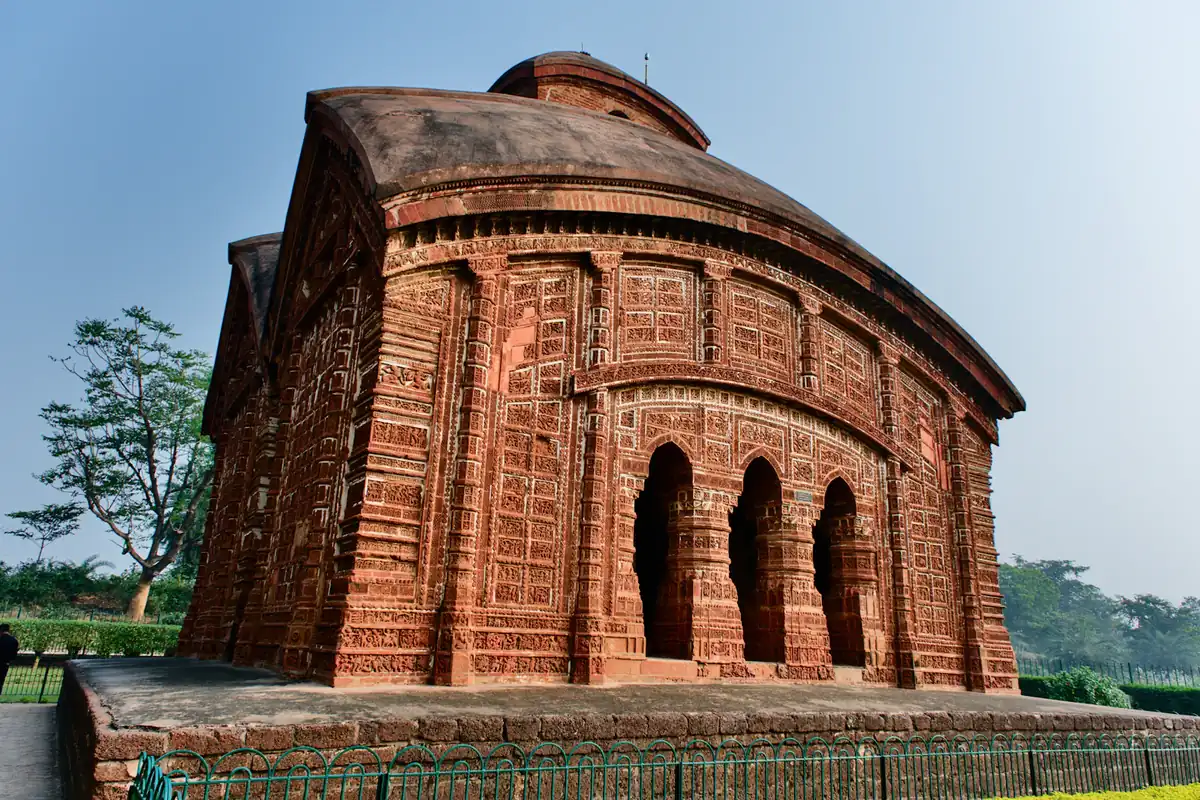
The tomb of Shah Ismail Ghazi, a warrior saint, stands on the mound.
Durgeshnandini and Gar Mandaran
Bankim Chandra set Durgeshnandini, 'the daughter of the fort's lord', in the reign of Akbar, during the wars between Mughals and Pathans in south-western Bengal. The Mughal general Jagat Singh falls in love with Tilottama, daughter of Birendra Singha, lord of the fort at Mandaran. The Pathan Katlu Khan storms the fort, and Katlu Khan's daughter Ayesha both shelters Tilottama and falls in love with Jagat Singh herself.
The novel mixes history with local legend from the Arambagh area, and went through 13 editions in the author's lifetime. It was later filmed in Bangla in 1927 and 1951 and in Hindi in 1956. For many readers a visit to Gar Mandaran is a literary pilgrimage as much as a historical one.
Visiting Gar Mandaran
Gar Mandaran lies on the Kamarpukur–Gar Mandaran–Kajla road, so it is easily added to a visit to Kamarpukur, Sri Ramakrishna's birthplace, and Jayrambati, birthplace of Sarada Devi. Totos and hired cars from Kamarpukur cover the short distance. Winter afternoons are pleasant for a walk on the mound.
Gar Mandaran: questions
Where is Gar Mandaran?
In the Goghat II block of Hooghly district, about 2 km from Kamarpukur.
What is the connection between Gar Mandaran and Durgeshnandini?
The ruined fort at Gar Mandaran is the setting of Bankim Chandra Chattopadhyay's 1865 novel Durgeshnandini, in which the heroine Tilottama is the daughter of the fort's lord.
Is there anything left of the fort?
Only a large mound and earthworks. The tomb of Shah Ismail Ghazi stands on top, and the area is maintained as a park.
Who ruled the Mandaran fort?
Many powers: local Sura chiefs, the Eastern Ganga and Gajapati kings of Odisha after 1256, the Bengal Sultans, Afghan rulers and the Mughals, who named a sarkar after Mandaran.