Updated
The 108 Shiva temples of Kalna, also called Nava Kailash, are the town's most famous sight: 108 small temples set in two concentric circles, built in 1809 by Maharaja Tej Chand of Bardhaman. Each temple holds a Shiva linga, and the plan is laid out so that all of them can be seen from the centre of the complex.
History
The Maharajas of Bardhaman were great temple builders, and Kalna, on the Bhagirathi, was where they built most lavishly. Maharaja Tej Chand, who ruled the Bardhaman Raj from the late 18th century until his death in 1832, raised this complex in 1809. West Bengal Tourism links it with the Raj's acquisition of the Bishnupur estate. It stands across the road from the older Rajbari temple complex built by his predecessors.
Both groups are now protected by the Archaeological Survey of India.
A garland of temples
The temples are small and stand side by side in two rings: 74 temples in the outer circle and 34 in the inner. The number 108 is sacred in Hinduism and matches the beads of a japa mala, and the rings are often compared to a rosary laid on the ground.
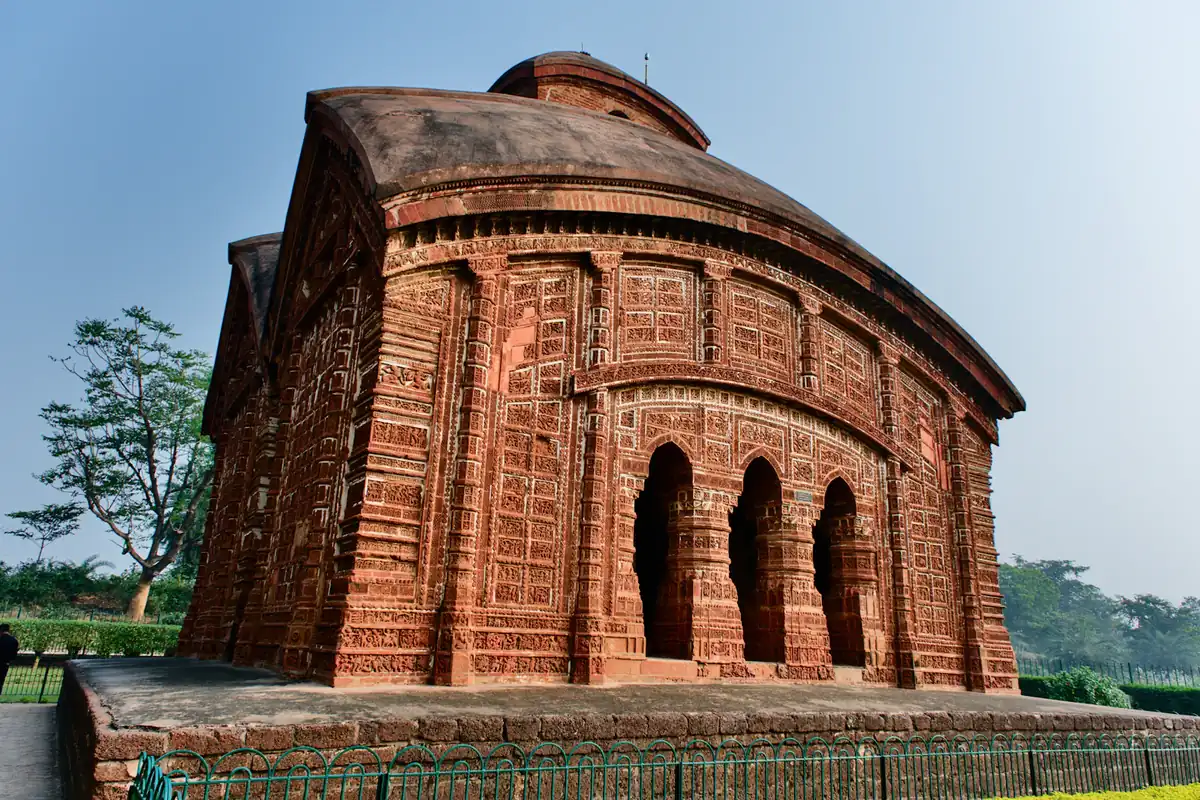
The lingas carry their own symbolism. Those in the inner circle are white; the outer circle has black lingas, all of them according to some accounts and half according to West Bengal Tourism, the rest white. West Bengal Tourism explains the outer ring as the everyday world of good and bad deeds, and the inner ring as the purified world reached through devotion to Shiva. Terracotta panels on the temple walls show scenes from the Ramayana and the Mahabharata, and hunting scenes.
Visiting
The complex is a short rickshaw or e-rickshaw ride from Ambika Kalna station. Walk into the centre to see the effect of the lingas in their two circles, then cross the road to the Rajbari complex for the Lalji, Krishnachandra and Pratapeswar temples. Allow an hour for both complexes, more if you want to study the terracotta.
108 Shiva Temples, Kalna: questions
When were the 108 Shiva temples of Kalna built?
In 1809, by Maharaja Tej Chand of Bardhaman.
How many temples are in each circle?
74 in the outer circle and 34 in the inner circle.
Why are some lingas black and some white?
The inner circle has white lingas and the outer circle black ones (sources differ on whether all or half are black). West Bengal Tourism describes the white as good deeds and the black as sins, with the inner ring standing for a purified world.
What is the other name of Kalna's 108 Shiva temples?
Nava Kailash (Naba Kailash), meaning the new Kailash, Shiva's mountain home.