Updated
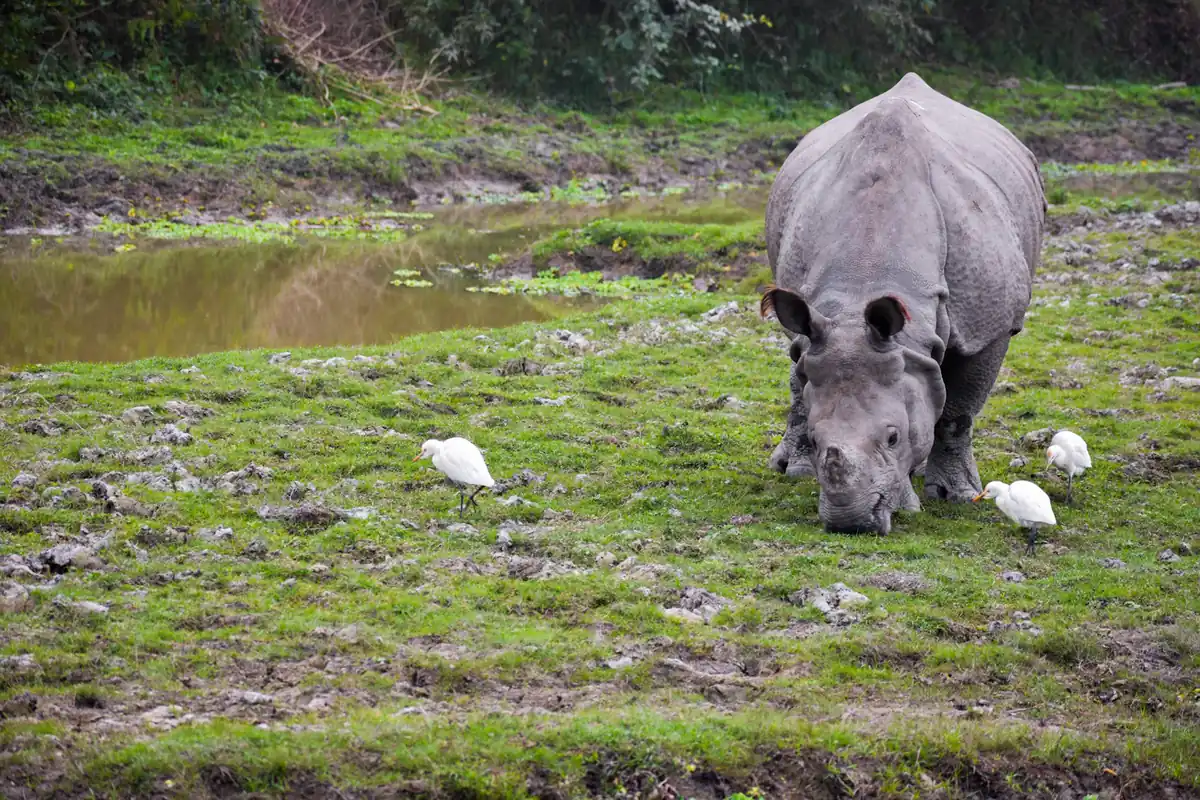
A safari is the only way into Jaldapara National Park, whose grasslands on the Torsa hold the largest population of one-horned rhinoceros in Paschim Banga. The forest department runs two kinds: rides on trained kunki elephants into the tall grass, and jeep safaris along several forest routes. Both are in heavy demand in the winter season, and the arrangements change from year to year, so it pays to know how the system works before you go.
Elephant safaris
Elephant safaris use the park's trained kunki elephants. In 2024 five kunkis were assigned to tourist rides. The number of rides is small: for the 2025 season the department scheduled seven elephant safaris a day in Jaldapara, and in October 2026 it put 48 elephant-ride seats up for advance online booking.
Online booking for elephant rides was withdrawn for several seasons, leaving visitors to queue for a handful of tickets on the spot, and was brought back by the forest department before Durga Puja in 2025. Check the current booking method and timings on the West Bengal forest department's eco-tourism portal (WBSFDA) before you travel; summer and winter timings differ, with winter timings starting on 1 November.
Jeep safaris and routes
Jeep (Gypsy) safaris start from several points around the park. In 2024 there were 45 safari vehicles running from Madarihat, Chilapata and Shalkumarhat, and in October 2026 the department listed 912 safari seats a day across five routes: Salkumar, Madarihat, Lankapara, Chilapata and Kodalbasti, with booking allowed up to a month ahead. Car safaris have at times been bookable only at the counter, so confirm the method for your dates.
Floods can interrupt the season. In October 2025 the Hollong river washed away a wooden bridge that gave access to the safari ticket counters, and all safaris were suspended while the forest department repaired the damage; silt was dumped across parts of the grassland.
Hollong and the safari season
Hollong, in the heart of the park, was for decades the best-known address in Jaldapara: a wooden forest bungalow built in 1967 as an inspection bungalow and opened to tourists in the 1990s, where guests watched animals over tea. It burned down on the night of 18 June 2024, when the park was closed and no visitors were present. The state sanctioned its reconstruction, in concrete and wood with eight rooms, and work began in early 2026.
The park closes for the breeding season, usually from mid-June to mid-September, and safaris resume when it reopens. Plan for October to May, and book early for the winter holidays and Durga Puja, when demand is highest.
Jaldapara Safari: questions
How do I book a Jaldapara elephant safari?
Elephant safaris are run by the West Bengal forest department. Online booking was reintroduced in 2025, with a limited number of seats each day. Check the forest department's eco-tourism portal (WBSFDA) for current booking, timings and fees.
Where do Jaldapara jeep safaris start?
Recent routes start from Madarihat, Salkumar (Shalkumarhat), Lankapara, Chilapata and Kodalbasti. Confirm the routes open for your dates.
When is Jaldapara closed?
National parks in Paschim Banga usually close from 16 June to 15 September each year. Floods can also suspend safaris at short notice.
What happened to Hollong Bungalow?
The 1967 wooden forest bungalow at Hollong was destroyed by fire on 18 June 2024. Reconstruction began in 2026.
Sources
- Jaldapara National Park (Wikipedia)
- UNI: Online safari booking at Jaldapara begins (Oct 2026)
- News Arena: Dooars elephant safaris return ahead of Durga Puja (Sep 2025)
- Millennium Post: No suspension of elephant, car safaris at Jaldapara (Aug 2024)
- Millennium Post: Forest minister vows early resumption of Jaldapara safaris (Oct 2025)
- Millennium Post: Iconic Hollong bungalow (Jun 2024)
- Millennium Post: Reconstruction of Holong bungalow begins (Feb 2026)
- WBSFDA information and notices