Updated
Chilapata is a dense forest in the eastern Dooars, close to Hasimara and the edge of Jaldapara National Park. It is famous as the elephant corridor linking Jaldapara with Buxa Tiger Reserve, for jeep safaris to the Mendabari watchtower, and for the ruined brick fort known as Nalraja Garh hidden among its trees. The Torsa and Bania rivers water the forest, and Rabha villages sit on its fringes.
Things to do in Chilapata Forest
Mendabari watchtower
The district administration names this tower as the best spot on a Chilapata safari to see the forest's animals.
Nalraja Garh
The overgrown ruins of an old brick fort inside the forest. Its origins are uncertain: some accounts tie it to the Koch king Nara Narayan, others to a much earlier dynasty.
Kodalbasti
The Chilapata range point from which forest safaris start, with a basic eco-tourism lodge run by the state forest development agency.
Bania river
A forest river where boating is offered, and where the Kalchini, Bania and Buri Basra streams meet.
Elephant corridor
Herds move through Chilapata between Jaldapara and Buxa, so drive slowly and follow forest staff instructions.
Jaldapara National Park
The rhino grasslands on the Torsa lie just to the west and combine easily with Chilapata.
The forest and its wildlife
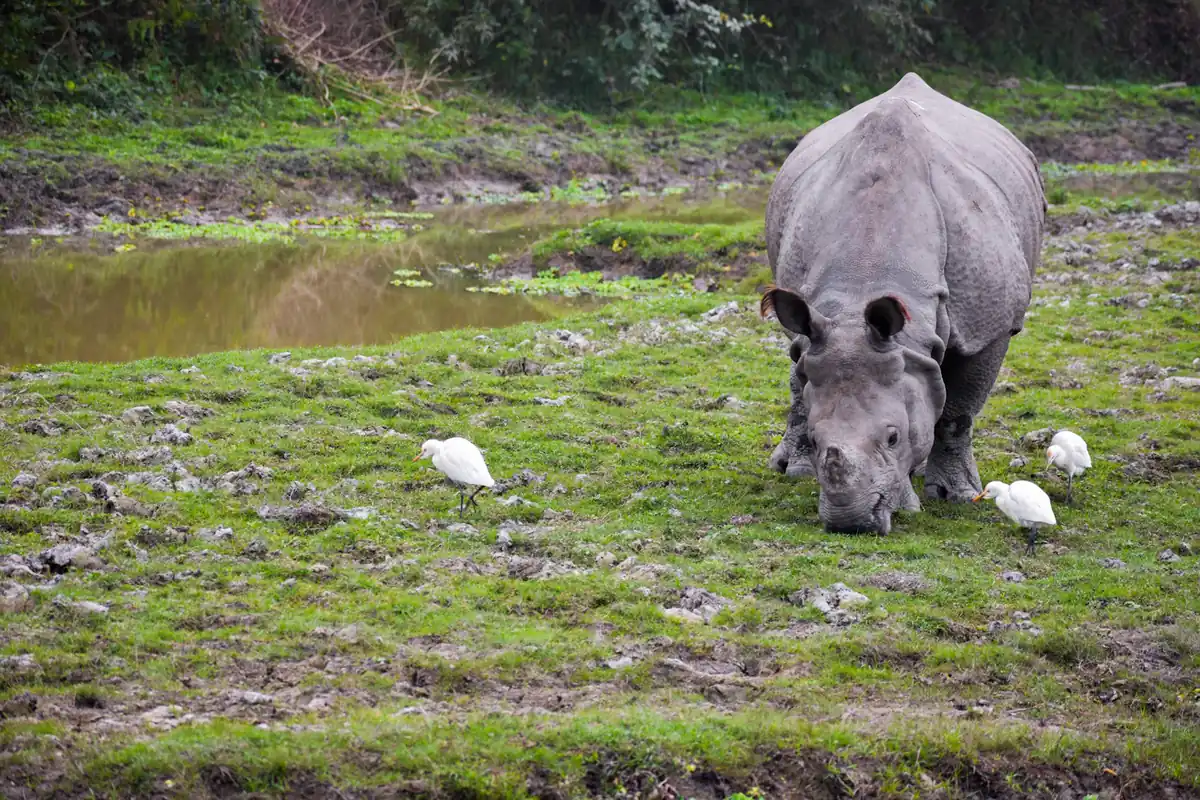
Chilapata lies in the heart of the eastern Dooars, where the plains meet the Himalayan foothills. The Torsa and Bania rivers lay down the alluvial soil that feeds its tall, damp forest, and it fills the gap between two big protected areas: Jaldapara National Park to the west and Buxa Tiger Reserve to the east. Asian elephants use it as a corridor between the two, and one-horned rhinos have been recorded moving through as well, though they are now very rarely seen here.
The district administration counts about 23 species of mammals, around 22 reptiles and about 180 species of birds in the forest, along with orchids. Animals you may meet on a drive include elephants, sambar, barking deer, hog deer, chital, wild boar, leopard and monkeys. Leopards are said to be still common.
Nalraja Garh and the Rabha villages
Nalraja Garh. Deep in the forest are the crumbling walls of a brick fort, the Nalraja Garh. Sources do not agree on who built it: one current account calls it Naranarayan Garh and credits the Koch king Nara Narayan, while older accounts link it to the Nal kings and date it as far back as the Gupta period. What is clear is that it is a ruin under the trees, unrestored and poorly protected, and is visited on the forest safari.
The Rabha community. The forest villages around Chilapata are home to the Rabha people, who have long depended on the forest for firewood and other needs. Community eco-tourism around Chilapata was promoted partly to give them an income from visitors instead.
How to reach Chilapata
By train. Hasimara station is about 10 km away and Alipurduar Junction or New Alipurduar about 28 km away.
By road. Chilapata is roughly an hour's drive from Alipurduar town and a short drive from Hasimara, and roads connect it with Siliguri and Cooch Behar.
By air. Bagdogra (IXB) is the nearest airport with regular flights.
Chilapata Forest: travel questions
What is Chilapata Forest famous for?
Chilapata is a dense forest in the eastern Dooars, close to Hasimara and the edge of Jaldapara National Park. It is famous as the elephant corridor linking Jaldapara with Buxa Tiger Reserve, for jeep safaris to the Mendabari watchtower, and for the ruined brick fort known as Nalraja Garh hidden among its trees.
What is the best time to visit Chilapata Forest?
The best time to visit Chilapata Forest is October to May.
How far is Chilapata Forest from Siliguri and Kolkata?
Chilapata Forest is about 130 km by road from Siliguri, about 3.5 hours by car. From Kolkata it is about 705 km by road via Siliguri, so most travellers fly to Bagdogra (IXB) or take an overnight train to New Jalpaiguri (NJP) and drive from there.
How do I reach Chilapata Forest?
By air: the nearest airport is Bagdogra Airport (IXB), Siliguri, about 4 hours by road. By train: Hasimara (about 10 km); Alipurduar Junction or New Alipurduar (about 28 km). By road: about 130 km from Siliguri.
What are the places to visit near Chilapata Forest?
Places near Chilapata Forest include Jaldapara National Park (about 16 km), Alipurduar (about 16 km), Rajabhatkhawa (about 20 km) and Madarihat (about 20 km). Distances are in a straight line.
Which district is Chilapata Forest in?
Chilapata is in Alipurduar district, in the eastern Dooars of Paschim Banga, near Hasimara and Jaldapara National Park.
What is Nalraja Garh?
The ruins of an old brick fort inside Chilapata Forest. Its builder and date are disputed: some sources credit the Koch king Nara Narayan, others the Nal kings of a much earlier period.
Can you see rhinos in Chilapata?
Rhinos have used the forest as a corridor from Jaldapara, but they are now very rarely seen in Chilapata itself. Jaldapara is the better place for rhinos.
Where does the Chilapata safari start?
Forest safaris start from the Chilapata range at Kodalbasti, and the Mendabari watchtower is the usual viewing point. Check current safari arrangements with the forest department.